The Missouri General Assembly is making progress on several important bills this session, with some now on the governor’s desk awaiting final approval. Lawmakers have been focused on protecting vulnerable Missourians, supporting student learning, and ensuring our communities remain safe and thriving.
Some of the highlights of this week include:

Missouri is taking an important step to address a growing concern in education the impact of excessive screen use on student behavior, learning, and long-term skill development. As House Bill 2230 advances, the conversation is shifting back to what research and classroom experience consistently show: children learn best through direct engagement, not passive interaction with screens.

Testimony before the Joint Committee on Education highlighted concerns such as shorter attention spans, weaker comprehension, reduced memory retention, and rising behavioral challenges. Experts, including Dr. Maryam Mohammadkhani, noted that screen-heavy learning conflicts with how children’s brains develop, with measurable declines in attention and cognitive processing. HB 2230 aims to restore balance and ensure that technology supports, but does not replace effective classroom instruction, helping students develop the focus and skills necessary for their long-term success.
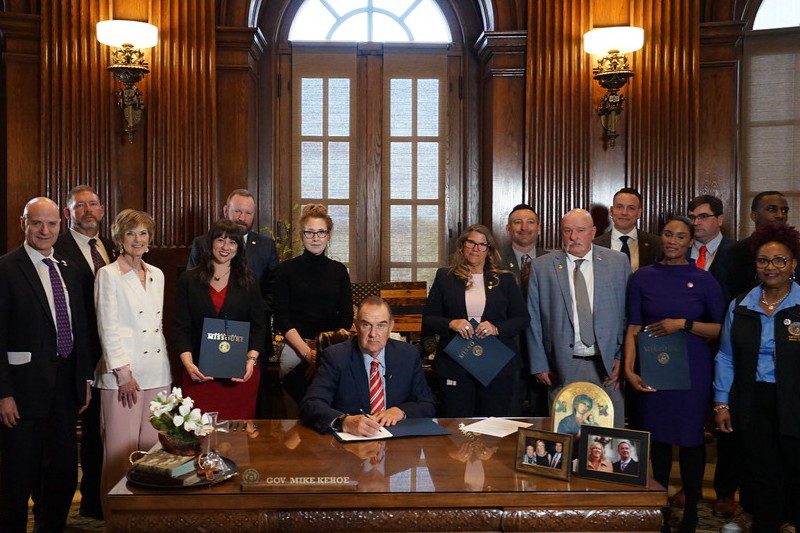
On the other hand, Governor Mike Kehoe signed three additional bills into law this week, bringing the total number of enacted measures this session to four. The legislation addresses public safety, family law, and protections for vulnerable populations: Senate Bill 888 updates the criminal justice system by improving law enforcement information sharing, enhancing penalties for certain sexual offenses, and streamlining sentencing and parole eligibility transparency; House Bill 1908 ensures pregnancy status cannot block access to divorce or legal separation; and House Bill 2273 strengthens penalties for crimes involving minors, addresses digitally manipulated explicit images, and bolsters efforts against child exploitation and trafficking.
Additionally, some of the legislation considered this week includes:
Antisemitism and Anti‑Discrimination Bill (HB 2061) The Missouri General Assembly gave final approval to a bill that would require public schools and higher education institutions to adopt policies prohibiting antisemitic discrimination and harassment. The bill now heads to the governor for consideration; if signed, Missouri would become the 39th state to adopt the International Holocaust Remembrance Alliance’s working definition of antisemitism.
Public Benefit Eligibility and SNAP Changes (HCS HB 2481) The Missouri House approved a bill modifying eligibility verification for public assistance programs (including SNAP and MO HealthNet). It would require proof of citizenship or eligible immigration status.
Firearm Suppressor Regulations Revised (HB 1730) The House approved legislation that would remove state‑level criminal penalties for certain suppressor‑related activities beginning in August 2026.
Cross‑Reporting Requirements for Abuse and Neglect (HCS HB 2292) The House approved legislation expanding mandatory reporting across agencies to better identify abuse involving people and animals.
Liability Protections for Teachers Intervening in Violence (HCS HBs 2913 & 3228) The House passed bills granting civil liability protections for teachers and school districts acting in good faith to stop violent incidents at school, aligning such actions with existing justified force standards and preventing school policies from restricting necessary intervention.
Expanded Adoption Support (HB 1772) The House passed a bill to expand adoption subsidies by covering legal costs (attorney fees and guardian ad litem expenses) for eligible adoptive families beginning in 2027 for five years to reduce barriers for children in state custody seeking permanent homes.
Expanded Adult Education Access (HB 3239) Passed by the House, this bill would allow individuals age 21+ without a high school diploma/equivalent to enroll in state‑approved virtual or full‑time programs through local districts or public higher education, participate in the state virtual course access system with performance‑based funding.
Nuclear Energy Financing Proposal (HCS HBs 2122 & 1626) The House approved legislation (the “Missouri Nuclear Clean Power Act”) allowing certain small‑scale nuclear facilities to recover construction costs in utility rates subject to Public Service Commission oversight, with cost recovery subject to refund and a sunset provision to encourage reliable baseload energy investment.
Broadband Equipment Tax Policy Changes (HCS HB 2711) House‑passed legislation would classify broadband infrastructure equipment as tangible personal property, create a temporary lower assessment rate for new broadband investments after August 2026 to incentivize expansion, and return to standard rates in later years.
Building Permit Process Reform (HB 1791) Approved by the House, this bill would streamline the building permit process with firm timelines, require prompt applicant communication, impose penalties for missed deadlines, clarify denial explanations, structure revisions, and allow limited post‑disaster work prior to permits while adjusting fire protection district authority in residential matters.
Small Employer Health Insurance Eligibility Rules (HCS HB 2465) The House passed a bill modifying how employees are counted under small employer health insurance laws, allowing family members working for the same employer to count separately, potentially expanding access to small group coverage.
Settlement Demand Standards (HB 2927) House‑approved legislation updating civil settlement demand requirements would mandate writing, certified mail delivery, and set timeframes to improve clarity and consistency in pre‑litigation negotiations.
Regulatory Guidance Protections for Financial Institutions (HB 3107) Passed by the House, this bill would shield financial institutions from civil liability when acting in good faith based on written regulatory guidance, even if such guidance changes later, while maintaining accountability for misconduct or negligence.
Real Estate Wholesaling Disclosure Requirements (HCS HB 2517) The House approved a bill requiring real estate wholesalers to provide written disclosures to property owners before contracts, allowing contract cancellation for non‑compliance, enabling enforcement under the Missouri Merchandising Practices Act, expanding tools for unlawful occupancy enforcement, and clarifying law enforcement liability protections.
Veterans’ Cemetery Restoration Fund (HCS HB 1869) The House approved legislation creating a grant program to assist with repairing and resetting grave markers for deceased veterans in private cemeteries, with per‑project award caps and first‑come distribution to support burial site preservation after natural damage.
It is an honor to serve,
Cathy Jo Loy
State Representative
District 163